Translatomics
Bridging the gap between RNA and proteins.
The translatome is the complete set of mRNAs actively being translated in a cell at a given time, along with the regulatory mechanisms that control their translation. While transcriptomics reveals which genes are expressed and at what level, mRNA abundance and the corresponding protein output are often poorly correlated, as a large proportion of gene expression regulation occurs post-transcriptionally at the level of translation.
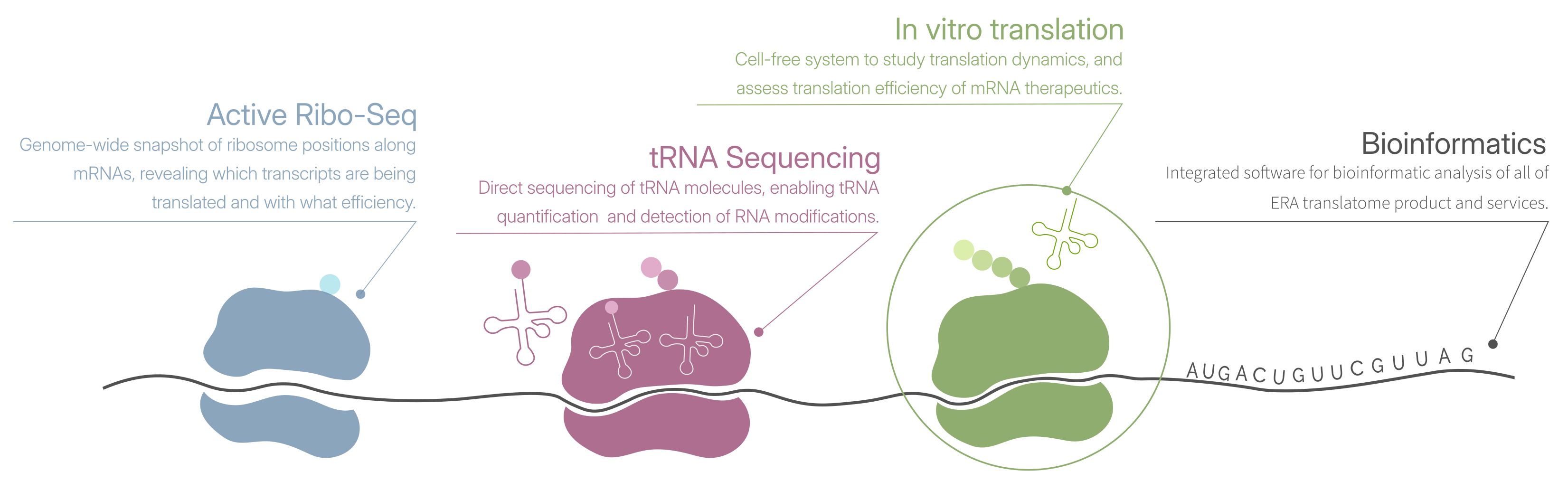
Through its Translatomics portfolio, ERA offers a set of complementary products and services covering different aspects of the translation machinery, enabling a comprehensive investigation of translational regulation:
Lowly transcribed mRNAs can be translated multiple times or by many ribosomes simultaneously, resulting in higher protein output than more abundant but less utilized transcripts. Moreover, environmental variables, cellular stress, and signalling activation can all rapidly alter translational regulation, often taking effect before any changes at the transcriptome level occur. Translatomics aims to decipher this mRNA-protein disconnect and characterize the molecular mechanisms underlying it, revealing how cells regulate gene expression beyond transcription. Since it is ultimately a cell's protein composition that defines its identity and function, reading translation directly, rather than inferring it from mRNA levels, is essential to understanding both healthy and diseased cells.
Translatomics to accelerate RNA drug development
Most disease-relevant proteins are not druggable, meaning that they cannot be targeted with conventional small molecule drugs, as they lack structural features (e.g., binding pocket or active sites) that can be targeted by small molecule-based approaches. It is estimated that only 10–15% of the human proteome falls within the druggable space, leaving most disease-driving proteins without a viable therapeutic strategy.
Targeting RNA instead of proteins is largely independent of these structural constraints. By acting at the mRNA level, either by silencing a transcript through RNAi or by delivering a therapeutic mRNA, RNA-based therapeutics can principally apply to any gene in the genome. However, not all mRNAs are translated equally, and translational efficiency can vary widely depending on sequence, structure, and cellular environment. Understanding how well a mRNA is translated and how the delivery of a therapeutic siRNA or mRNA affects translation and its off-target effect within the cell is therefore critical for predicting therapeutic efficacy and safety. Translatomics provides the tools to address these questions directly, offering a genome-wide, quantitative view of translation that complements transcriptomic data and enables a more complete assessment of RNA therapeutic activity.
Translatomics and Cancer Biology
Cancer cells are characterized by widespread transcriptional dysregulation and the correlation between mRNA and protein abundances is particularly low. Perturbations can affect different components of the translational machinery, including the ribosome, the tRNAs and translation factors. The ribosome itself can be remodelled, with altered compositions that preferentially translate specific subsets of mRNAs — giving tumours a way to reshape their proteome that is invisible to transcriptomics alone.
Over the last few years, translatomics research has expanded our understanding of how cancer cells remodel gene expression beyond the transcriptional level. Of particular interest is the emerging class of microproteins — small proteins of fewer than 100 amino acids encoded by short open reading frames in regions of the transcriptome previously annotated as non-coding. Ribo-Seq has revealed that many of these small ORFs are actively translated, and a growing number of microproteins have been shown to play functional roles in cancer cells. Because these short ORFs are defined by active ribosome occupancy rather than by sequence annotation, active Ribo-Seq is particularly well suited to discovering them and telling genuinely translated microproteins apart from background.
The role of tRNAs is also being increasingly investigated, and by leveraging the Oxford Nanopore Direct RNA Sequencing platform it is now possible to simultaneously characterize RNA modifications within tRNA sequences and quantify changes in tRNA abundance across cancer cell lines and different environmental or biological conditions.
Translatomics and Infectious Diseases
Viruses are dependent on the host translational machinery to produce their proteins and have evolved strategies to redirect ribosomes to translate viral mRNAs while simultaneously suppressing host protein synthesis. Translatomics can reveal these dynamics, providing genome-wide, quantitative maps of both host and viral translation during infection. Ribo-Seq has been applied to the study of different infectious diseases including SARS-CoV-2, influenza and HIV. Looking beyond ribosome positioning, profiling the tRNAs engaged with ribosomes shows that infection selectively reshapes this pool to match the codon demand of viral mRNAs — a translational adaptation that leaves total tRNA levels unchanged and therefore remains invisible to bulk measurements.
Translatomics and Neuroscience
Neurons depend on translation happening at the right place and the right moment. Messenger RNAs are transported far from the cell body and translated locally at synapses, where protein synthesis underlies processes such as memory and synaptic plasticity — exactly the spatial and temporal control that transcriptomics cannot capture. Here, translatomics, and active ribosome profiling, make it possible to see which transcripts are being translated in neural tissue and how that program breaks down in neurological and neuromuscular disease.
From basic discovery to cancer biology, neuroscience, and RNA drug development, translation is where gene expression is ultimately decided — and for too long it has been the hardest layer to measure. ERA's Translatomics portfolio turns the active translatome into a direct, quantitative readout, opening the ribosome to researchers across every field where protein synthesis matters.
References
- Hofman, D. A., Prensner, J. R., & van Heesch, S. (2025). Microproteins in cancer: identification, biological functions, and clinical implications. Trends in Genetics, 41(2), 146-161.
- Kibe, A., Buck, S., Gribling-Burrer, A. S., Gilmer, O., Bohn, P., Koch, T., ... & Caliskan, N. (2025). The translational landscape of HIV-1 infected cells reveals key gene regulatory principles. Nature Structural & Molecular Biology, 32(5), 841-852.
- Lauria, F., Bernabò, P., Tebaldi, T., Groen, E. J. N., Perenthaler, E., Maniscalco, F., ... & Viero, G. (2020). SMN-primed ribosomes modulate the translation of transcripts related to spinal muscular atrophy. Nature cell biology, 22(10), 1239-1251.
- Liu, Y., Beyer, A., & Aebersold, R. (2016). On the dependency of cellular protein levels on mRNA abundance. Cell, 165(3), 535-550.
- Machkovech, H. M., Bloom, J. D., & Subramaniam, A. R. (2019). Comprehensive profiling of translation initiation in influenza virus infected cells. PLoS pathogens, 15(1), e1007518.
- Monti, M., Yilmaz, H., Del Piano, A., Arnoldi, M., Bonomo, I., Llovera, L., ... & Novoa, E. M. (2026). Selective profiling of translationally active tRNAs and their dynamics under stress. bioRxiv, 2026-03.
- Posner, Z., Yannuzzi, I., & Prensner, J. R. (2023). Shining a light on the dark proteome: Non‐canonical open reading frames and their encoded miniproteins as a new frontier in cancer biology. Protein Science, 32(8), e4708.
- Puray-Chavez, M., Lee, N., Tenneti, K., Wang, Y., Vuong, H. R., Liu, Y., ... & Kutluay, S. B. (2022). The translational landscape of SARS-CoV-2-infected cells reveals suppression of innate immune genes. MBio, 13(3), e00815-22.
- Vaklavas, C., Blume, S. W., & Grizzle, W. E. (2017). Translational Dysregulation in Cancer: Molecular Insights and Potential Clinical Applications in Biomarker Development. Frontiers in oncology, 7, 158