
In vitro translation
ReCet™ is Immagina Biotechnology’s reconstituted cell-free translation platform for studying protein synthesis outside the cell. Rather than relying on a single crude lysate, ReCet is built on a tripartite architecture that separates the three core components of a translation reaction — purified ribosomes, a ribosome-depleted cytoplasmic extract, and an exogenous reporter mRNA — and lets you recombine them at will. Because each component can be held constant while another is varied or treated, ReCet makes it possible to isolate and measure the specific contribution of each part of the translation machinery to protein output, something conventional all-in-one systems cannot do. The reaction runs in a physiologically relevant human background, is read out within one hour by luminescence (for luciferase-encoding mRNA) or Western blot, and is supplied as a standardized, shelf-stable, ready-to-ship kit. ReCet is currently available for HEK293T and K562 cells, with custom formulations from other cell lines available on request.
Why reconstitute translation?
Studying translation inside living cells is complicated by the fact that cells adapt: perturb one factor and the whole gene-expression programme shifts, making it hard to attribute an effect to any single part of the machinery. Cell-free translation systems remove that confounder, and they have been a cornerstone of molecular biology for decades — but most classic systems are rigid, and many rely on non-human sources such as rabbit reticulocyte lysate, wheat germ, insect cells or E. coli, where regulators can be missing or mechanisms species-specific.
Even the human cell-free systems available until recently kept the ribosomes locked together with the surrounding cytoplasm, so the ribosome’s own contribution could not be separated from that of auxiliary factors. ReCet’s tripartite design breaks this deadlock: ribosomes, cytoplasm and mRNA are delinked from their original cellular context and recombined on demand, giving a level of experimental control — and druggability — that intact lysates cannot offer.
What you can do with ReCet
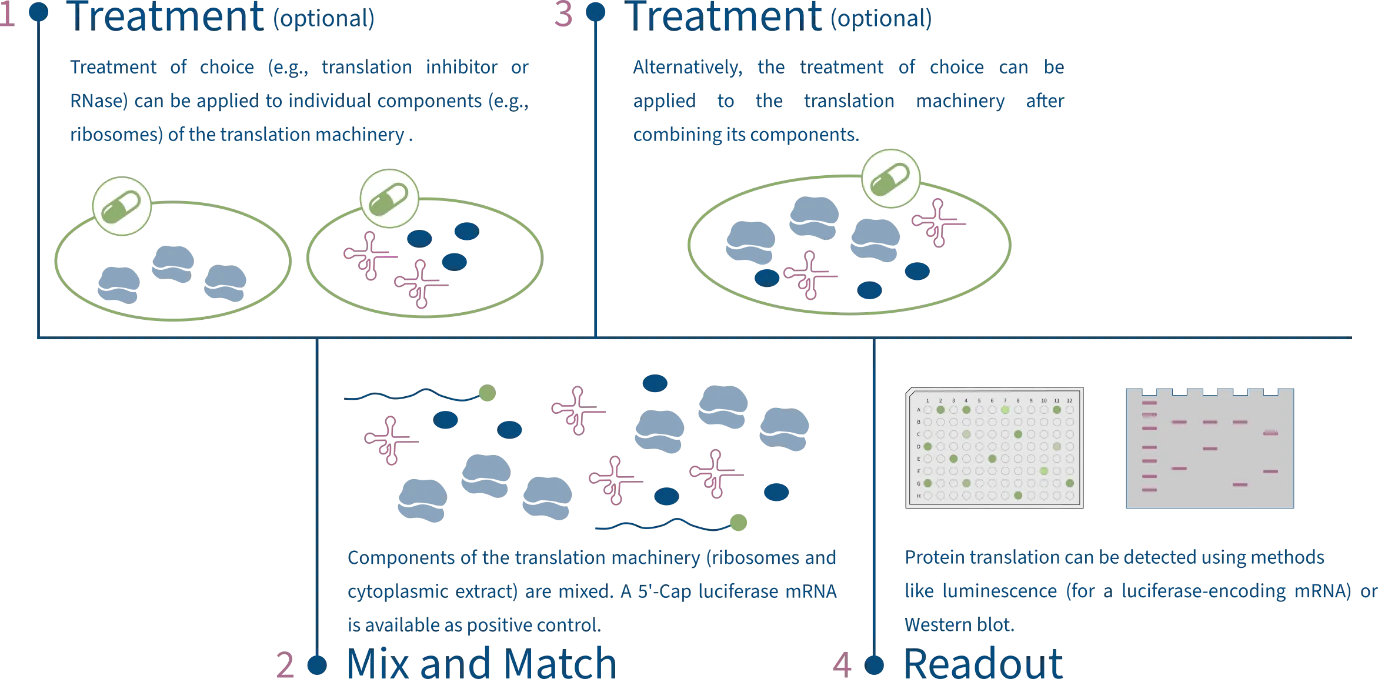
ReCet is purpose-built for translation-focused drug discovery. It can screen and validate novel translation inhibitors, measure the translational efficiency of therapeutic mRNAs, dissect how mRNA cis-elements such as UTRs tune expression in a cell-type-specific setting, and screen RNA-targeted small molecules — with treatments applied either to individual components before assembly or to the fully reconstituted reaction.
The same modularity opens up translation biology. By treating one fraction while holding the others constant, researchers can pinpoint which part of the machinery senses or is damaged by a given stress — for example in the ribotoxic stress response. It is also a natural system for studying ribosome heterogeneity: because the components come apart, ribosomes purified from one extract can be combined with the cytoplasmic extract of another — or challenged with a defined pool of mRNAs — to reveal how specialized or heterogeneous ribosome populations, and distinct cytoplasmic factor compositions, change what gets translated and how efficiently.
ReCet is also useful for producing proteins that are difficult to make in other systems, including cytotoxic proteins and proteins needed for downstream enzyme-activity assays, and for expressing full-length products with cell-type-appropriate modifications. It is optimized for mechanistic and screening work rather than for large-scale protein production.
The ReCet workflow
Originally developed by the Lund group at the University of Copenhagen and turned into a ready-to-use kit by Immagina Biotechnology, ReCet addresses the main drawbacks of earlier in vitro translation systems. Its defining feature is modularity: unlike conventional lysate-based systems, the ribosomes, cytoplasmic extract and mRNA are provided separately, so the contribution of each translation player can be studied in isolation. In practice, the ribosome extract, cytoplasmic extract, translation buffer, salts, ATP, RNase inhibitor and reporter mRNA are combined on ice and incubated for one hour at 37 °C (extendable up to three hours), after which newly synthesized protein is detected by luminescence, Western blot, GFP fluorescence, [35S]-methionine labelling or biotin-tagged (Transcend) tRNA. mRNA can be used directly as input, with no need to clone the sequence of interest beforehand, and any component can be treated before assembly — giving a fast, flexible, mix-and-match route to quantitative translation data.
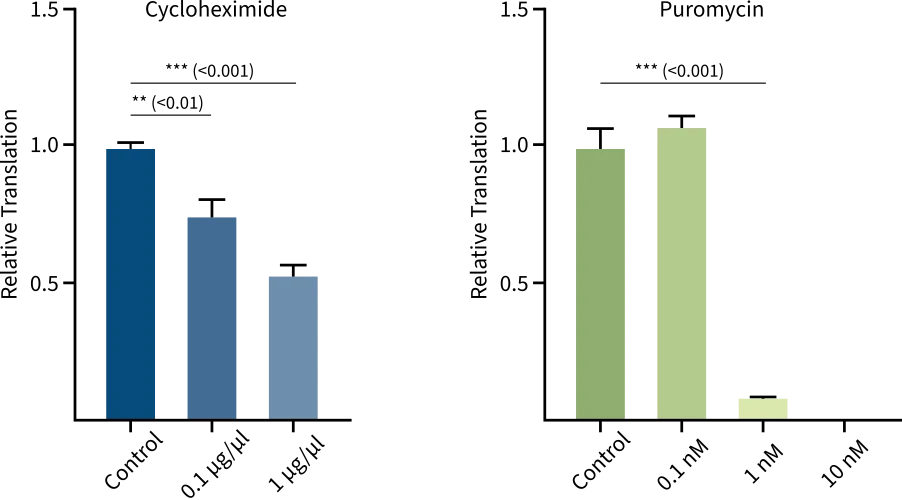
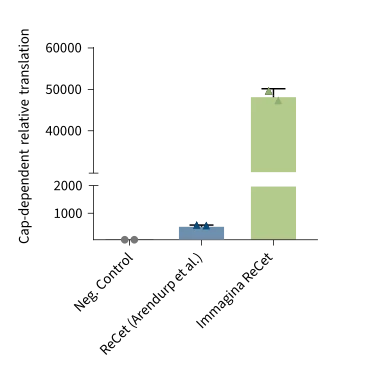
That convenience is matched by performance. Although ReCet is inspired by the tripartite method published by Arendrup et al. (Nature Protocols, 2025), Immagina has re-engineered it for output and reproducibility. The dose-dependent suppression of translation by cycloheximide and puromycin shows how cleanly and reliably the system responds (Figure 2), while the payoff of the optimization is striking: using the same capped Firefly-luciferase reporter, ReCet reaches a cap-dependent signal more than an order of magnitude above the original protocol (Figure 3).
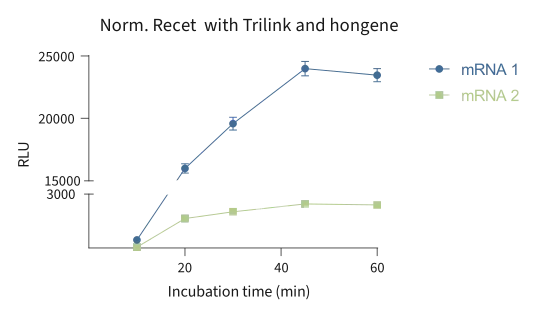
This larger, cleaner window does not come at the expense of fidelity: ReCet faithfully reproduces the translation-efficiency differences driven by mRNA UTRs — two reporters that share the same coding sequence but carry different UTRs give distinct, reproducible outputs — and the signal follows a clean logarithmic curve that peaks around 45–60 minutes (figure 4).
Custom configuration
Each ReCet kit provides 30 reactions and ships on dry ice, with a shelf life of about 12 months when stored as specified. Beyond the catalogue HEK293T and K562 systems, Immagina can prepare custom ReCet kits from other cell types or conditions and can supply matched ribosome and cytoplasmic fractions from different backgrounds so that components can be compared head-to-head in the same reaction. Custom formulations are available on request — just get in touch to describe your cell model of interest.
How can we help?
ERA — through its member Immagina Biotechnology — supports researchers across the whole ReCet workflow, from choosing the most suitable cell model and designing mix-and-match or treatment experiments to detection and downstream data interpretation. Whether you need a catalogue kit, a custom system built around your own cells, or help turning a translation question into a tractable cell-free assay, get in touch with the ERA team.
References
- Arendrup, F. S., Andersen, K. L., & Lund, A. H. (2025). A tripartite cell-free translation system to study mammalian translation. Nature Protocols.
- Aviner, R. (2020). The science of puromycin: from studies of ribosome function to applications in biotechnology. Computational and Structural Biotechnology Journal, 18, 1074–1083.
- Schneider-Poetsch, T. et al. (2010). Inhibition of eukaryotic translation elongation by cycloheximide and lactimidomycin. Nature Chemical Biology, 6, 209–217.
- Ryder, L. et al. (2023). Nitric oxide-induced ribosome collision activates ribosomal surveillance mechanisms. Cell Death & Disease, 14, 467.
- Philipp Koch, . et al. (2026). Synthetic circRNAs employ IRES activity for translation in cells and in cell-free translation systems bioRxiv 2026.03.28.715045; doi: https://doi.org/10.64898/2026.03.28.715045