
Oligonucleotides synthesis
From sequence to synthesis: custom oligos and RNA therapeutics research tools, made in-house.
Modern RNA research and molecular diagnostics depend on a steady, reliable supply of custom nucleic acids — primers, probes, guide RNAs, antisense oligonucleotides, and small interfering RNAs (siRNAs) — each requiring precise sequence, chemistry, and purity to perform as intended. Sourcing these reagents externally often means long lead times, batch-to-batch variability, and limited flexibility to iterate quickly on design. An in-house oligonucleotide synthesis capability removes that bottleneck, giving researchers and assay developers direct control over turnaround time, chemistry, and quality at every step of a project.
Through its in-house Oligonucleotide Synthesis Department, MultiplexDX offers custom production of DNA and RNA oligonucleotides across a broad range of chemistries and applications, supporting everything from routine molecular biology to advanced RNA therapeutics research:
- Unmodified DNA and RNA oligos — standard synthesis of primers, probes, and single-stranded templates at high purity and reliable yield, produced fast enough to keep pace with iterative experimental design.
- Modified oligonucleotides — a wide range of backbone and sugar modifications, including phosphorothioate (PS) linkages for enhanced nuclease resistance, and 2′ sugar modifications (2′-OMe, 2′-F, and related chemistries) for improved stability, binding affinity, and reduced immunogenicity — the same chemistries underlying clinically relevant siRNA and antisense oligonucleotide design.
- siRNA duplexes — design and synthesis of single- and double-stranded siRNAs incorporating modified nucleotides, for use in RNAi-based gene silencing studies, target validation, and mechanism-of-action research.
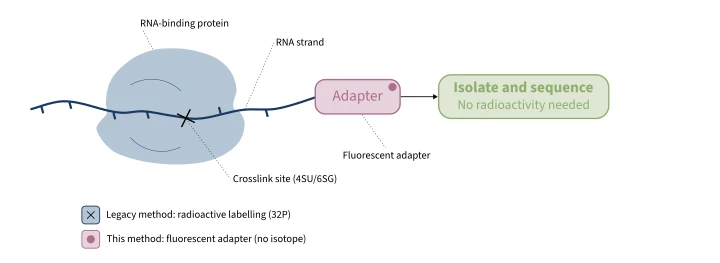
- Fluorescently and chemically labelled oligos — custom conjugation and labelling to support hybridization-based assays and specialized RNA biology workflows. This includes fluorescently labelled, barcoded, pre-adenylated 3′ RNA adapters for use in fluorescent PAR-CLIP (fPAR-CLIP) protocols — ligated directly onto crosslinked RNA on immobilized RNA-protein complexes to map RNA-binding protein target sites, offering a non-radioactive alternative to traditional ³²P-labelled CLIP adapters for cleaner, safer library preparation (Anastasakis et al., 2021).
All oligonucleotides are produced with high purity and specificity, with fast turnaround and reliable batch-to-batch consistency — production is optimized for research and diagnostic applications rather than clinical manufacturing (the facility does not hold GMP certification and is therefore not intended for use in the production of therapeutic products for clinical administration).
A track record of scale
MultiplexDX's capacity to deliver oligonucleotides reliably and at scale is not theoretical. During the COVID-19 pandemic, MultiplexDX developed the primers and probes underpinning ten distinct RT-qPCR and LAMP-based COVID-19 test kits — spanning standard and rapid extraction-free formats, pan-SARS-CoV-2 and variant-specific designs, and multi-pathogen assays — with an initial production run of over 100,000 test kits delivered to Slovak diagnostic laboratories and subsequently scaled to support testing programmes in other countries.
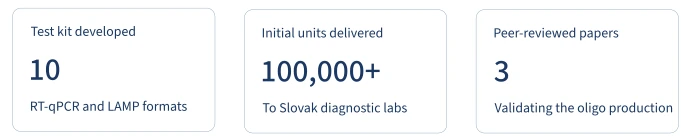
This capability is documented across several peer-reviewed publications: a nationwide surveillance study of the B.1.1.7 (Alpha) variant across Slovakia, screening nearly 7,000 samples, relied on primers and probes synthesized by MultiplexDX's in-house oligonucleotide synthesis and production team (Boršová et al., 2021); a further study describes the sequential development of an entire family of RT-qPCR assays using LNA-modified nucleotides and dual-probe technology to differentiate SARS-CoV-2 from influenza (Radvánszka et al., 2022); and a third describes the development of an ultrasensitive, quadruplexed LAMP-based test using LNA-modified primers for extraction-free, gargle-sample point-of-care testing (Szobi et al., 2023). Meeting this demand required the rapid, high-throughput production of primers and probes across many parallel designs, without compromising the sensitivity and specificity the assays depended on. That same infrastructure and quality discipline now highlights MultiplexDX's custom oligonucleotide synthesis service, giving partners confidence that orders — however large, complex, or time-sensitive — can be produced fast and right the first time.

Supporting RNA therapeutics research
siRNA- and ASO-based therapeutics rely on precisely engineered chemistries — phosphorothioate linkages, 2′-fluoro and 2′-O-methyl modifications, and sequence-specific targeting — to achieve stability, cellular uptake, and on-target silencing while minimizing off-target and immune effects. MultiplexDX's in-house synthesis capability allows research teams to rapidly prototype and test candidate designs, screen chemistry and modification patterns, and validate silencing efficiency before committing to larger-scale or GMP production runs elsewhere. This makes MultiplexDX a valuable early-stage partner for groups developing RNAi therapeutics, antisense candidates, and other oligonucleotide-based modalities.
From routine primers to fully modified siRNA duplexes and specialized CLIP adapters, MultiplexDX's in-house oligonucleotide synthesis gives researchers and assay developers fast, flexible access to the custom nucleic acids their work depends on.
References
- Anastasakis, D. G., Jacob, A., Konstantinidou, P., Meguro, K., Claypool, D., Cekan, P., Haase, A. D., & Hafner, M. (2021). A non-radioactive, improved PAR-CLIP and small RNA cDNA library preparation protocol. Nucleic Acids Research, 49(8), e45.
- Boršová, K., Paul, E. D., Kováčová, V., Radvánszka, M., Hajdu, R., Čabanová, V., Sláviková, M., Ličková, M., Lukáčiková, Ľ., Belák, A., Roussier, L., Kostičová, M., Líšková, A., Maďarová, L., Štefkovičová, M., Reizigová, L., Nováková, E., Sabaka, P., Košcálová, A., Brejová, B., Staroňová, E., Mišík, M., Vinař, T., Nosek, J., Čekan, P., & Klempa, B. (2021). Surveillance of SARS-CoV-2 lineage B.1.1.7 in Slovakia using a novel, multiplexed RT-qPCR assay. Scientific Reports, 11, 20494.
- Radvánszka, M., Paul, E. D., Hajdu, R., ... & Čekan, P. (2022). Sequential development of several RT-qPCR tests using LNA nucleotides and dual probe technology to differentiate SARS-CoV-2 from influenza A and B. Microbial Biotechnology, 15(7), 1995–2021.
- Szobi, A., Buranovská, K., Vojtaššáková, N., Lovíšek, D., Özbaşak, H. Ö., Szeibeczederová, S., Kapustian, L., Hudáčová, Z., Kováčová, V., Drobná, D., Putaj, P., Bírová, S., Čirková, I., Čarnecký, M., Kilián, P., Jurkáček, P., Čabanová, V., Boršová, K., Sláviková, M., Vaňová, V., Klempa, B., Čekan, P., & Paul, E. D. (2023). Vivid COVID-19 LAMP is an ultrasensitive, quadruplexed test using LNA-modified primers and a zinc ion and 5-Br-PAPS colorimetric detection system. Communications Biology, 6, 233.