
Linear plasmid DNA (pDNA)
Linear plasmid DNA (pDNA) is a fundamental starting material for the production of synthetic mRNAs through in vitro transcription, where structural purity and complete linearization of the template directly affect downstream mRNA transcript quality.
High-quality circular parental pDNA is a critical starting material for subsequent enzymatic linearization. For this reason, robust pDNA manufacturing processes (Figure 1), including stringent quality control readouts, are required to guarantee efficient downstream linearization and final product purity. Anemocyte has a longstanding expertise in pDNA manufacturing offering great flexibility both in terms of production scales, going from mg to multi-gram production batches, and quality, providing both R&D-grade reagents but also GMP-ready materials. Besides its use as a template for mRNA manufacturing, pDNA is commonly used to produce viral vectors (e.g. AAV, lentiviral/retroviral vectors) which can have direct applications in patients as therapeutic agents.
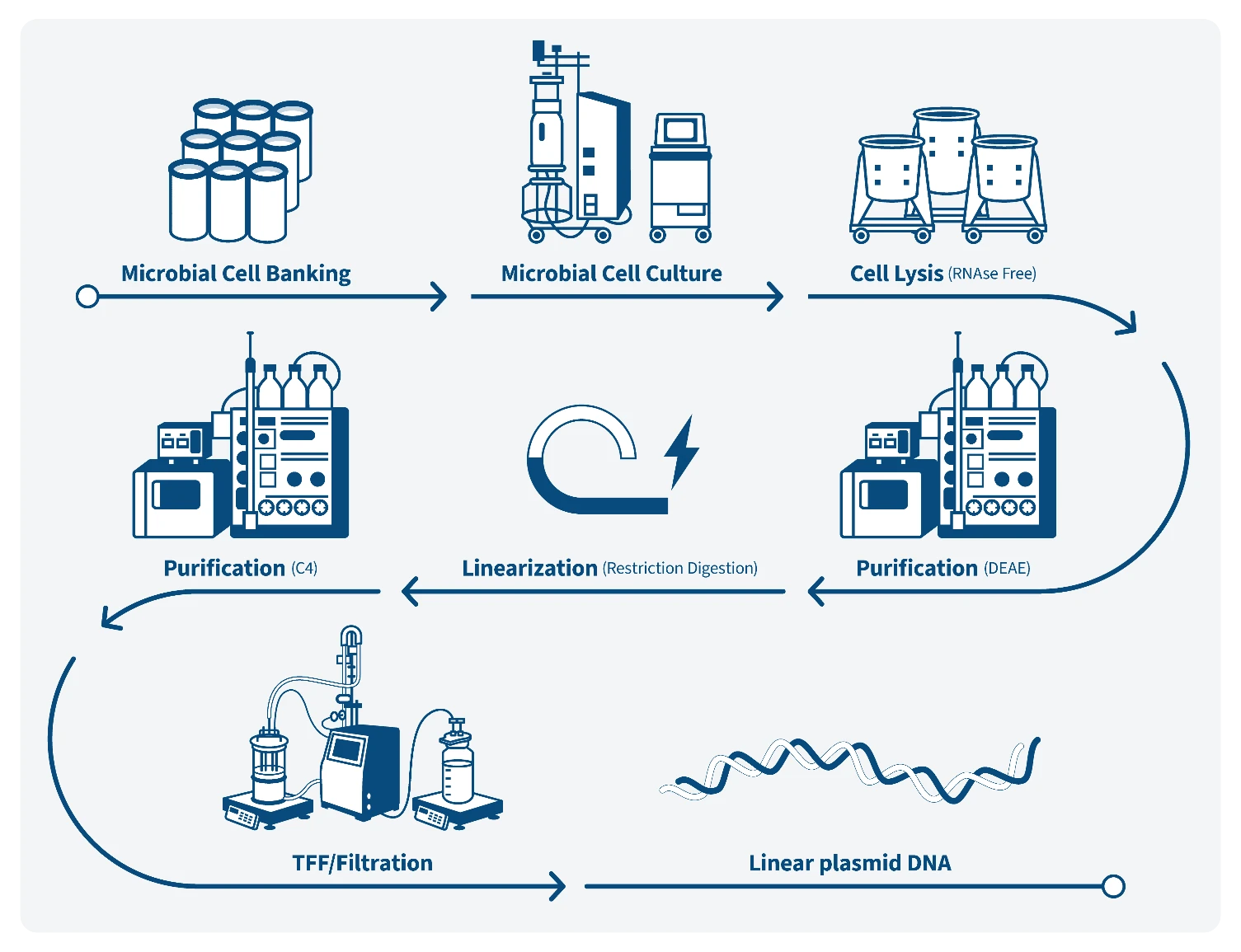
Among the biggest challenges in producing high-quality linear plasmid DNA are contaminations from sheared host genomic DNA (gDNA), incomplete enzymatic digestion of the parental circular plasmid and residual endotoxin levels. Additionally, the genetic stability of the plasmid construct must be ensured, especially in the presence of unstable sequences such as repeats in the transgene or a long poly(A) tail at the end of the transcript.
Step 1: Bacterial Fermentation
Starting from a desired construct, plasmid DNA manufacturing begins with host strain selection, a key step to ensure high yields and genetic stability of the DNA molecule during amplification. Multiple E. coli strains, as well different growth conditions (e.g. growth temperature), are screened to identify the best suited combination to obtain high quality and high quantities of the desired plasmid. Typically, for pDNA encoding long unstable poly(A) tracts or inverted repeats typical of mRNA templates, specialized strains like are exploited to prevent sequence rearrangement or poly(A) tail truncation.
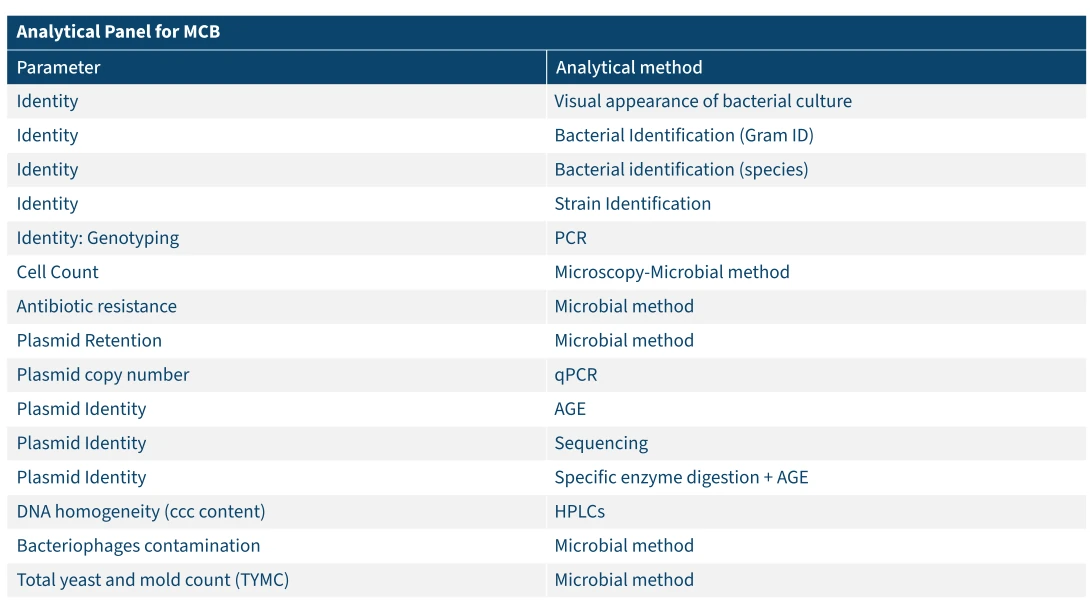
When requested, to guarantee process reproducibility and regulatory compliance, a rigorously qualified Master Cell Bank (MCB) may be established by selecting a single, sequence-verified colony from a freshly transformed host, expanding it in defined, animal-component-free media and cryopreserving a sufficient number of aliquots. MCB release testing requires verifying cell identity and viability, plasmid retention rate, full-length sequence identity and freedom from bacteriophage or adventitious host contamination. Anemocyte routinely tests in house all the generated MCB to ensure quality and compliance (Table 1).
The selected bacterial clone is then grown to high-density through fed-batch fermentation: parameters such as temperature, agitation speed, dissolved oxygen, pH and feed rate (typically using glycerol or glucose) are precisely controlled to maximize biomass density and plasmid copy number. Once peak cell density and plasmid yields are reached, the biomass is harvested by centrifugation or Tangential Flow Filtration (TFF).
Step 2: Downstream processing
The obtained biomass is then processed by controlled alkaline lysis using a mixture of NaOH and SDS. Neutralization parameters and mixing shear forces must be precisely regulated to prevent host genomic DNA shearing, which generates short DNA fragments that are biochemically very similar to plasmid DNA molecules during downstream capture and can remain as contaminants in the final plasmid preparation. When the lysate is neutralized, the denatured host proteins, SDS and genomic DNA precipitate into a thick flocculate, while the smaller, covalently closed supercoiled pDNA rapidly renatures and remains soluble. The lysate is then clarified using depth filtration to remove the precipitated biomass and is then concentrated and buffer exchanged for further downstream steps.
The processed lysate contains the target supercoiled pDNA alongside large quantities of host RNA, endotoxins (lipopolysaccharides) and open-circular (nicked) pDNA isoforms. Separation is obtained through Anion Exchange chromatography (AEX): by exploiting the high negative charge density of the pDNA phosphate backbone, AEX serves as a robust primary capture step to concentrate the product and wash away weakly bound proteins and small RNAs. A further buffer exchange through TFF is then required for downstream linearization.
Step 3: Linearization and final polishing
Once the supercoiled pDNA precursor has been isolated, it undergoes a bulk restriction digest. The supercoiled pDNA is incubated with the selected restriction endonuclease, which should cut immediately downstream of the poly(A) tail of the construct. Only restriction endonucleases yielding blunt or 5′-overhang ends are used; 3′-overhang-generating enzymes must be avoided to prevent spurious, non-specific RNA transcription during downstream in vitro transcription applications. This step must be driven to ≥99% completion since any residual circular template may lead to the generation of unwanted longer transcripts during the downstream IVT reaction, reducing the purity of the final mRNA product.
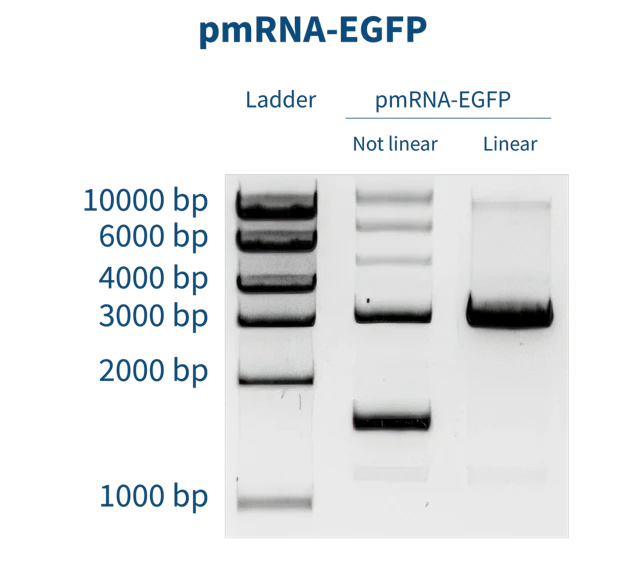
Following digestion, the restriction enzyme and residual contaminants need to be cleared. Secondary polishing chromatography (typically Hydrophobic Interaction Chromatography, HIC) is exploited specifically to remove the endonuclease, along with residual traces of host cell proteins and endotoxins. A final step of concentration and buffer exchange via TFF allows to obtain the final linearized plasmid product (Figure 2), ready for in vitro transcription.
Quality control
Verifying quality requirements is a key final step both in plasmid DNA manufacturing workflows and after the linearization step. Anemocyte offers custom testing panels (Table 2) which are tailored based on the client quality control requests and can be performed both on internally produced materials or externally manufactured pDNA batches provided by the client.
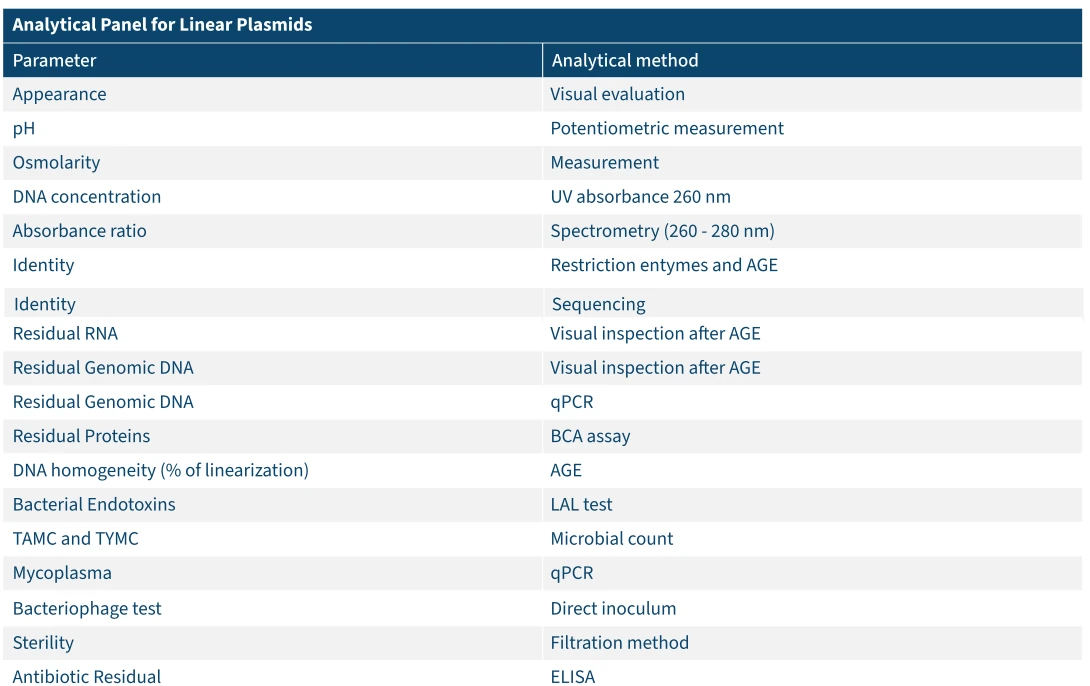
Besides classical physicochemical measurement on the final linearized plasmid product (e.g. concentration, pH, appearance), some of the assays which are most commonly included in analytical panels are used to evaluate:
- Sequence identity & structural integrity. Quality control for plasmid DNA (circular and linear) relies on stringent structural and sequence verification to ensure downstream transcription fidelity. Long-read sequencing (for example using the Oxford Nanopore platform) or Sanger sequencing is deployed to confirm sequence identity. Agarose gel electrophoresis (AGE) serves as the primary assay to quantify linearization efficiency, requiring ≥99% conversion to the linear isoform.
- Host- and process-derived impurity quantification. Ensuring safety and preventing potential toxicities during downstream applications requires rigorous screening for residual host-cell components and process reagents. Quantitative PCR (qPCR) is used to verify with high sensitivity that residual host genomic DNA (gDNA) remains below strictly defined limits (typically <1.0% w/w), while biochemical assays can be used to measure residual host cell proteins and restriction endonucleases. Endotoxin clearance is validated using the Limulus Amebocyte Lysate (LAL) assay, maintaining levels below 0.1 EU/µg of pDNA to prevent endotoxin-induced cytotoxicity in subsequent cellular transfections or in vivo studies.
Anemocyte offers custom plasmid manufacturing services, covering multiple scales and quality grades, including the production of highly pure linearized plasmid DNA to be directly used as a template in IVT reactions. For commonly used reporter genes (e.g. EGFP, luciferase, mCherry) and enzymes (e.g. Cas9, Cre), off-the-shelf ready to use R&D grade linear pDNA templates are available for direct purchase.